
Four Lessons from a Firefighter Confidence Course
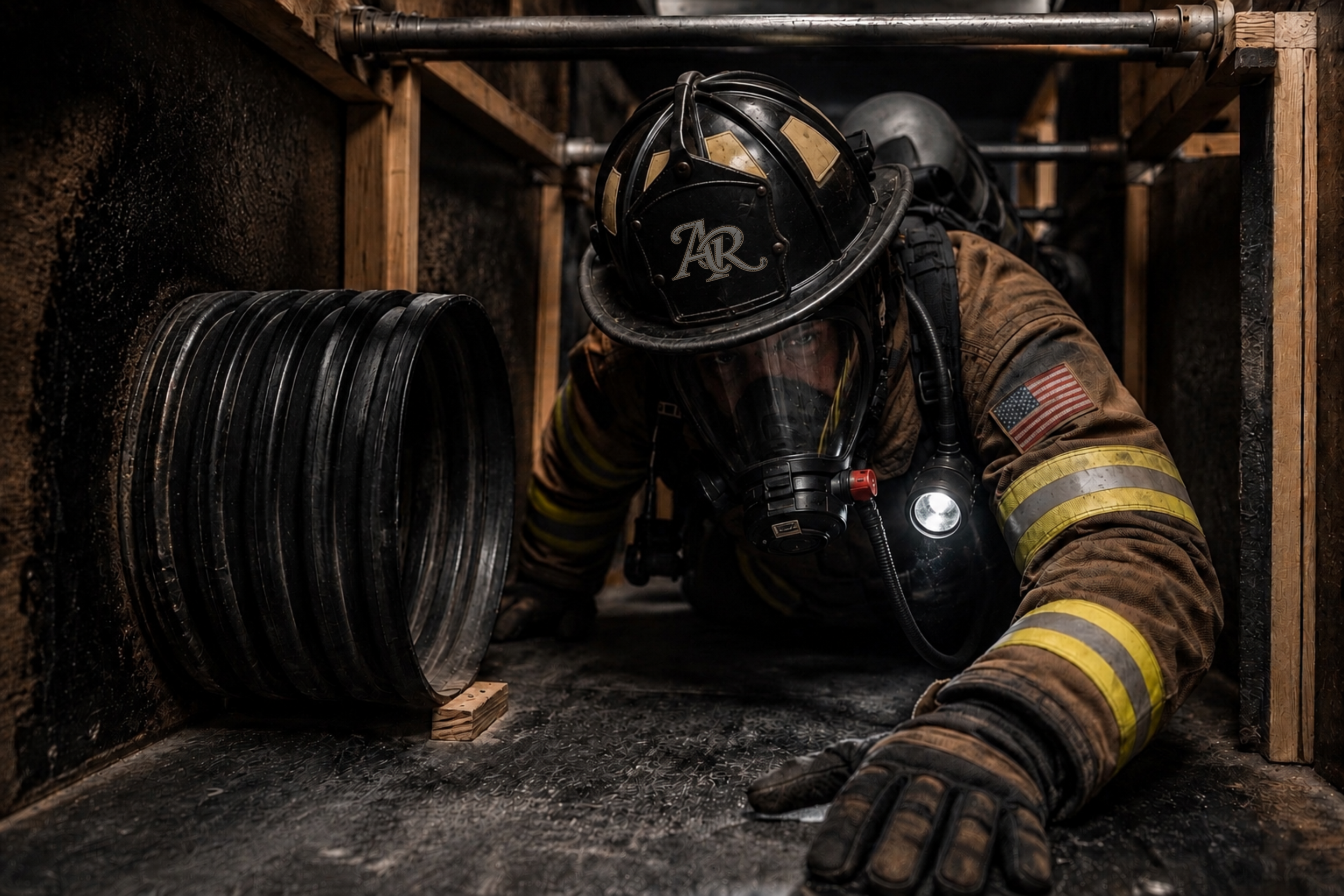
One of the more useful lessons I carried into medicine came from a firefighter confidence course. Just before leaving for PA school, I spent five weeks in a cadet fire academy here in Arizona. It was there that I was first introduced to the firefighter confidence course.
Those five weeks were one of the more physically and mentally demanding things I had done at that point in my life. The cadet academy forced me to confront my physical limitations. Through the confidence course, I also began to understand my physiological limitations—how breathing, vision, orientation, and decision-making can all be affected under stress.
Now, I should be clear: I am by no means an expert in confidence courses, SCBA management, or structural firefighting. My experience took place entirely under controlled, simulated conditions— a very different thing from relying on those skills when the environment is unpredictable and the consequences are real.
I left with a tremendous amount of respect for the men and women who operate in those environments every day.
But I also left with lessons that followed me well beyond the cadet fire academy. Now years later, I can see many of those same lessons in medicine, leadership, and life.

What is a firefighter confidence course?
For anyone unfamiliar, a firefighter confidence course is basically an obstacle course completed in full turnout gear while wearing an SCBA. The course is designed to recreate some of the challenges firefighters may face inside a structure—restricted openings, confined spaces, entanglements, changes in elevation, unstable surfaces, and zero visibility.
The application is straightforward.
A firefighter may become disoriented or lost while operating in smoke. While attempting to locate an exit, that firefighter may encounter obstacles, become entangled, lose orientation, or feel the effects of a diminishing air supply.
They still have to continue working.
They still have to solve problems.
They still have to manage their equipment, breathing, air consumption, and physiological response to panic.
So the question is not simply:
Can you physically get through the obstacle?
It is closer to:
Can you continue thinking, breathing, managing your equipment, solving problems, and making deliberate decisions when your environment is telling you to panic?
At the time, I thought I understood the purpose of the course.
Make us uncomfortable.
See who could remain calm.
Maybe weed out the cadets who could not handle it.
That explanation was not entirely wrong, but it was oversimplified.
Years later, I think there was a much larger lesson buried in that training—one that has followed me into medicine, leadership, entrepreneurship, parenthood, and life outside of work.
These are the four lessons that stayed with me.
1. Composure is a skill
The confidence course deliberately creates an environment where your normal senses and abilities are degraded.
You are breathing through an SCBA.
You are wearing heavy equipment.
You cannot see.
Your movement is restricted.
Your heart rate rises.
Your breathing changes.
You may not be able to completely control that initial physiological response.
But you can control what you do next.
Composure is not the absence of an emotional or physiological response. It is maintaining control of your actions despite it.
And in the real environment the course is preparing you for, losing control has a very real cost.
Your air supply is finite. The faster you breathe, the faster you consume it. Add physical exertion, restricted movement, darkness, uncertainty, and the sound of your own breathing inside the mask, and the pressure builds quickly.
That stress is part of what you are learning to manage.
You begin to recognize how your breathing changes under stress and workload. You learn that unnecessary movement, frustration, and panic consume the same resources you need to get yourself through the problem.
The harder you fight the environment without thinking, the more air and energy you use.
Panic has a cost.
Outside the confidence course, the resources may be different, but the principle is the same.
Panic narrows your thinking. It makes communication less effective. It pushes you toward immediate reactions rather than deliberate decisions
It uses resources without necessarily moving you any closer to solving the problem.
Composure is not passive.
It is resource management.
Medicine demands the same kind of composure.
A crashing patient does not care whether you are nervous. Your team does not necessarily need you to feel calm. They need you to remain capable of thinking.
In trauma, the room can become loud quickly. Information may be incomplete. Several problems may be happening at once. People are waiting for decisions, and those decisions carry real consequences.
You may still feel the stress of the situation. Experience does not make you immune to it. What changes is your ability to function inside it.
Over time, situations that once felt overwhelming become more manageable because you have seen variations of them repeatedly. You recognize patterns. You know what needs to happen next.
The same principle applies personally.
Being a dependable spouse, parent, or friend does not mean never experiencing fear, anger, uncertainty, or anxiety.
It just means those emotions do not automatically get control of your behavior.
The goal is not to feel nothing.
The goal is to remain capable of choosing what you do next.
2. Confidence should come from competence, not ego
In medicine, confidence is necessary. Patients want to see it. Teams rely on it.
There are moments when hesitation can be just as consequential as the wrong decision.
But I also see plenty of ego.
The two can look remarkably similar from the outside.
Both can speak with certainty. Both can take control of a room. Both can appear completely comfortable making decisions.
The difference is what that confidence is built on.
Competence-based confidence has been earned through preparation, experience, failure, repetition, and an understanding of your own limitations. Ego-based confidence needs to appear capable, even when it isn’t.
One of the things I appreciated about the cadet fire academy was being reminded that everyone is a beginner at some point.
Firefighters do not build confidence because someone repeatedly tells them, “You’ve got this.”
They learn the equipment.
They practice the movements.
They encounter problems.
They struggle.
They fail under controlled conditions.
They repeat the process.
Eventually, the progression changes:
I have never done this.
I have practiced this.
I have struggled with this.
I understand what the problem feels like.
I know what I am capable of—and what I am not.
That is a much more durable form of confidence.
Medicine works the same way.
You do not become confident by trying to convince yourself that you are prepared. You build confidence by preparing, acting, reflecting, correcting, and repeating.
A confidence course is not meant to teach you that you are invincible. If anything, it should teach the opposite.
Know what you can do.
Know what your equipment can do.
Know how your body responds under stress.
Know when you are approaching your limits.
Know when the situation has changed.
That is calibrated confidence.
Confidence is not believing that nothing bad will happen.
It is understanding your capabilities, trusting your preparation, and recognizing when the problem has moved beyond them.
The same distinction matters when we talk about masculinity.
There is a version of masculinity built around appearing capable at all times.
Never admitting uncertainty.
Never asking for help.
Always having an answer.
But that is often ego disguised as confidence.
Real confidence allows you to say, “I don’t know.”
It allows you to enter someone else’s environment and become the beginner.
It allows you to ask for instruction without feeling diminished by it.
It allows you to recognize that a situation has exceeded your current abilities before your ego makes it worse.
Your identity is not threatened by not knowing something.
Confidence built on appearance is fragile.
Confidence built on competence is much harder to shake.
3. Do not confuse discomfort with inability
Imagine the confined-space portion of the course.
You are in full equipment. You cannot see. The space is narrowing around you. Your gear may be catching on something, your breathing is getting faster, and your brain is telling you:
I do not like this.
I want out.
That is useful information.
But it does not necessarily mean:
I cannot do this.
Those are two completely different statements.
The confidence course is not designed to make you ignore fear or suppress every warning signal from your body.
It teaches you to recognize the stress response without automatically surrendering your ability to assess the situation.
Am I actually in danger?
Am I outside of my capabilities?
Is my equipment failing?
Am I doing something incorrectly?
Or is this simply difficult and uncomfortable?
That distinction matters almost everywhere.
Walking into an unfamiliar clinical situation can be uncomfortable while still being within your capability.
Starting a business can make you question yourself without meaning you made the wrong decision.
Parenting can leave you completely unsure of yourself without meaning you are failing.
Sometimes quitting would immediately eliminate the discomfort.
That is precisely why discomfort can be such a poor decision-making tool.
If the only goal is to feel better as quickly as possible, quitting, avoiding, deflecting, or walking away will often work.
At least temporarily.
But immediate relief is not always evidence of a good decision.
The better question isn’t:
How do I make this feeling stop?
It is:
What is this feeling actually telling me?
There are times when fear is protective.
There are times when discomfort is evidence that you are outside of your capabilities or moving toward a dangerous decision.
There are also times when discomfort simply means you are doing something difficult, unfamiliar, or consequential.
The lesson is not to ignore fear.
It is to assess it.
The course teaches you that you can be uncomfortable and still function.
You can feel restricted and continue thinking.
You can feel uncertain and continue solving the problem.
You can want out and still decide that the next responsible action is to stay engaged.
Maybe confidence is not becoming comfortable in uncomfortable situations.
Maybe it is learning that discomfort does not have to dictate what you do next.
4. You do not need to see the exit to make the next good decision
This may be my favorite lesson.
In a blackout confidence course, you may not know exactly where the exit is.
You cannot see the entire obstacle.
You may not know what is waiting on the other side of the opening or what you will encounter around the next turn.
You know where you are.
You know what your training tells you.
You assess what is immediately around you.
You make the next appropriate movement.
Then you reassess.
When visibility disappears, you fall back on what you have practiced.
You use touch.
You maintain orientation.
You manage your equipment.
You follow established procedures.
You don’t let incomplete information become a reason to stop moving.
Most of life works the same way.
You do not know exactly where your career will be in ten years.
You cannot predict what will happen with a business.
You do not know every challenge your children will encounter.
You cannot guarantee a medical outcome.
Leadership rarely gives you complete information.
Major life decisions rarely come with guarantees.
Waiting until you can see the entire path would mean never moving.
Instead:
Assess.
Make the best decision available.
Move.
Reassess.
That is not recklessness.
It is learning to operate responsibly with incomplete information.
There is humility in that process.
You make the best decision you can with what you know, while remaining willing to adjust when the situation changes or new information becomes available.
You do not have to pretend you can see the entire path.
You only need enough awareness, preparation, and judgment to make the next good decision.
Becoming more capable within it
When I entered that cadet academy, I assumed the confidence course was mostly a test—make us uncomfortable, see who could remain calm, and find out who could handle it.
Years later, I think the lesson was much simpler—and much more useful.
The goal was never to make an uncomfortable environment comfortable.
It was to become more capable within it.
The environment is still uncomfortable.
The restriction is still real.
Your air is still finite.
You still cannot see.
What changes is the person operating inside it.
I think the same thing is true in the rest of life.
Medicine has not become less consequential as I have gained experience. I have become better at functioning inside its uncertainty.
Adulthood has not given me certainty. I have just become more capable of making decisions without it.
And becoming a better man is not about eventually reaching a point where nothing scares, overwhelms, frustrates, or challenges you.
It is about becoming someone who can still be deliberate, dependable, humble, and useful when those things happen.
Maybe confidence is not believing everything will be okay.
Maybe it is knowing that when things are not okay, you can still decide what to do next.

